GoThere/Palm Springs

GoThere before you go there 


PS, I Love You!

.....and Cathedral City, La Quinta, Indian Wells, Palm Desert Rancho Mirage & Indio

Palm Springs California
Palm Springs is a reasonable drive from San Diego or Los Angeles -- and easily accessible by air from anywhere. Palm Springs California

Come over for the mild winters or the dry summers.

 Visit 273 other cities online

© 2001-2007 GoThere.comSM GoThere before you go thereSM


From Wikipedia, the free encyclopedia


Coordinates: 33°49′26″N, 116°31′49″W
County Riverside
City Manager David H. Ready
Area
- City 246.3 km˛
- Land 244.1 km˛
- Water 2.2 km˛
Population
- City (2005) 45,731
- Density 185.7/km˛
- Metro 410,974
Time zone PST (UTC-8)
- Summer (DST) PDT (UTC-7)

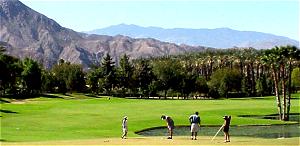
Palm Springs is a famed Riverside County, California, desert resort city, approximately 110 miles east of Los Angeles. As of the 2000 census, the city population was 42,807. Palm Springs contains some of the world's most famous golf courses. Swimming, tennis, horseback riding, and hiking in the nearby desert and mountain areas are other major forms of recreation in Palm Springs. It is one of nine adjacent cities that make up the Coachella Valley (Palm Springs area). The area code for Palm Springs is 760. The ZIP codes for Palm Springs are 92262 through 92264.

Once known as the "Playground of the Stars," Palm Springs is a small city with the legacy, amenities, and history of a large, cosmopolitan city. Palm Springs lies at the foot of one of Southern California's most majestic mountain peaks, 10,834-foot-tall Mount San Jacinto, whose eastern flank abuts downtown. It is not unusual to swim in 80 degree weather while looking up at snow covered peaks.

Palm Springs' heyday is generally considered to be the 1930s to 1970s. Before then, the town had been a popular winter getaway for rich families from the East Coast and Midwest. But it was Hollywood's adoption of Palm Springs as a very public playground that put it on the covers of Life and the movie fan magazines and created its reputation for glamour, wealth, healthy outdoor living, and relaxation. Palm Springs came to be a favorite destination, if only seasonally, for many of Hollywood's most glamorous stars, and the list of actors, directors, and producers who had houses there, mostly in the Las Palmas and Movie Colony neighborhoods, includes Clark Gable, Al Jolson, Greta Garbo, Cary Grant, Gloria Swanson, Steve McQueen, Howard Hughes, Jack Warner, Donna Reed, Bob Hope, Elvis Presley, Liberace, Debbie Reynolds, Lucille Ball, Desi Arnaz, Dinah Shore, Sonny Bono {former mayor}, Cher, Kirk Douglas, Jack Benny, Frank Sinatra and Dean Martin. In addition, several U.S. presidents, including Dwight Eisenhower, John F. Kennedy, Ronald Reagan, and George W. Bush, have visited, and Gerald Ford has a house in nearby Rancho Mirage.

Palm Springs' famous "playground of the stars" tagline has its origins from this period, when celebrities and the Hollywood elite flocked to Palm Springs to see and be seen in one of its many nightclubs, country clubs, hotels, poolsides, and restaurants. Charles Farrell's Racquet Club (opened with fellow actor Ralph Bellamy), the Hotel Mirador, Irwin Schuman's Chi Chi nightclub, George and Ethel Strebe's Doll House nightclub, Irwin and Mark Schuman's Riviera Hotel, Vic Sudaha's Palm House restaurant, the Foldesy family's Polynesian restaurant, Palm Springs Hotel, Trader Vic's restaurant, Aloha Jhoe's restaurant and bar, Tom O'Donnell's golf course, the Deep Well Guest Ranch, the Desert Inn, the Del Tahquitz hotel, and the Oasis hotel were some of the more popular destinations.

In a less glamorous light, the mid-century period was also marked by a two significant events which exposed elements of the City's underlying problems with corruption, racism, and poverty.

In 1959, landmark legislation by the Secretary of the Interior equalized allotted Indian lands, thereby setting the stage for development of Indian lands within the City of Palm Springs. This same legislation, however, recognizing the potential value of Indian lands within the boundaries of a world famous resort, also called for the appointment of conservators and guardians to "protect" Indians and their estates from "artful and designing persons" who might otherwise cheat them out of their properties, which could now be legally sold by the individual tribal members who owned them. By declaring Indians as "incompetent," court appointed conservators and guardians took control of a majority of Indian estates. A major oversight of the program was the appointment of judges, lawyers, and business people as Indian conservators and guardians -- the very people the program sought to protect Indians and their estates from. The program was administered by the Indio Superior Court's Judge Hilton McCabe, subject of the Ed Ainsworth's Golden Checkerboard. Bolstered by the ability to control valuable Indian estates, the conservatorship program fostered corruption among those conservators and administrators with their own economic agendas. A series of Pulitzer Prize winning Press Enterprise articles authored by journalist George Ringwald exposed such instances of excessive fees, fee-splitting, and other types of questionable conduct. The conservatorship program was officially ended in 1968 after the Secretary of the Interior's Palm Springs Task Force likewise exposed it as fraudulent and corrupt.

As the 1970s drew to a close, increasing numbers of retirees began moving to the Coachella Valley. As a result, Palm Springs began to evolve from a winter resort that became a virtual ghost town each summer into a year-round retirement community. Businesses and hotels that formerly shuttered for July and August started staying open all summer. As commerce grew, so too did the number of families with children. However, in general the 1970s and 1980s were a period of economic decline for Palm Springs.

The City began to show signs of economic recovery in the 1990s. Mid-century houses built in an architectural style now fashionable again began selling for many times their 1980s asking prices. Ironically, it was the economic stagnation of the 1970s and 1980s that preserved much of Palm Springs' mid-century architectural heritage. The decade or so from the late 1990s to the present has been a period of architectural renovation and preservation, due in great part to an influx of young, urban expatriates with an appreciation for mid-century design. Businesses, inns, and other enterprises have in turn begun catering to the tastes of these new arrivals, heralding a mid-century modern renaissance.

Also contributing to Palm Springs' economic revival has been the arrival of Indian gaming. In addition to the creation of a broad employment base and the development of a new type of local tourism (gambling), the tribe contributes a percentage of its profits to philanthropic causes and local infrastructure, such as the Palm Springs Fire Department, Palm Springs Public Library, and Boys and Girls Club of the Coachella Valley.


Architecture
Designed by architects Albert Frey and Robson C. Chambers in 1965, the iconic Tramway Gas Station was purchased by the City of Palm Springs in December 2002 and reinvented as the Palm Springs Visitors Center. Photo Courtesy of City of Palm SpringsPalm Springs is notable for having the highest concentration of mid-century modern architecture in the United States and was recently recognized by the National Trust for Historic Preservation for its dedication to preserving mid-century modern architecture. However, destruction of period architecture in favor of new business enterprises continues to be a source of contention between developers and organizations committed to the preservation of historic structures. A contemporary example of this struggle is the controversy concerning the Wessman Development Company's desire to demolish the Town & Country Center designed by architects A. Quincy Jones and Paul R. Williams.

The post-war era period drew famed architects such as John Lautner, Richard Neutra, Rudolf Schindler, William Cody, Albert Frey, Donald Wexler, and E. Stewart Williams to Palm Springs. Anchored in the Bauhaus movement, such architects adapted modern materials, techniques, and floor plans to the unique requirements of desert living. Inspired by the starkness and beauty of the desert, an aesthetic popularly known as Desert Modernism was born. Notable for its use of glass, clean lines, natural and manmade materials, and indoor/outdoor spaces, Desert Modernism defined a lifestyle of elegant informality.

Iconic modernist structures in Palm Springs include Albert Frey's Tramway Gas Station, Donald Wexler's airport, E. Stewart Williams' Coachella Savings & Loan, Richard Neutra's Kaufmann House, and Palmer & Krisel's House of Tomorrow.

A home developer, the Alexander Construction Company, popularized a modernist post-and-beam architectural style during this period. Alexander houses feature low pitched roofs, wide eaves, open-beamed ceilings and floor-to-ceiling windows to create an indoor/outdoor ambiance most suitable for private, pool-side living in a desert climate. The Alexanders built over 2,200 houses in the Coachella Valley between 1947 and 1965 and played an important role in securing Palm Springs' a place in modernist history.

Students and aficionados of mid-century architecture and design come to Palm Springs to study and pay homage to its unique heritage. A number of local organizations have also been formed in recent years to advocate this heritage and to help preserve it, ensuring that Palm Springs' architectural legacy can be appreciated by future generations.

Although Palm Springs has traditionally been a conservative city, the 2006 gay and lesbian population in Palm Springs is estimated to be about seven times the national average. [1] This concentration is even greater than that of San Francisco, which has approximately five times the national average. Gay residents represent about 35 percent of those who are year-round residents.

Ron Oden was elected to City Council in 1995. In 2003, he became the City's first gay mayor. Many interpreted his rival's defeat, former Mayor Kleindienst, as a reactionary vote against Kleindienst's purported ambivalence towards the City's burgeoning gay community.

Celebrities still retreat to Palm Springs, but today the city's economy focuses on tourism, real estate, health care, shopping, and gambling. It is a city of numerous festivals, conventions, and international events. While many young teens living in palm springs will pledge that it is a boring town with absolutely nothing fun to do, this is not entirely true for the rich and wealthy upper class

Palm Springs, because of its beauty and resort style of living, has had special appeal to senior citizens and the gay community. With the peace and spirituality of its desert and mountain setting, and its many activities and points of interest, Palm Springs is again attracting the attention of international travelers, young people, and those who want to live in or retire to one of the most unusual and attractive resort areas in North America.

Indian Canyons, Palm Springs. The Indian Canyons are an often overlooked wonder. The canyons surrounding Palm Springs and their associated resources are sacred to the Cahuilla and are historically important to Cahuilla history, scientists, and nature lovers. Tahquitz Canyon and three southern canyons are listed in the National Register of Historic Places. Palm and Andreas Canyons are known as the world's largest and second largest California fan palm (Washingtonia filifera) oases, with Murray Canyon listed as fourth. While in Palm Canyon, visit the Trading Post for hiking maps, refreshments, Indian art and artifacts, books, jewelry, pottery, baskets, weavings and conversational cultural lore.

Downtown's Palm Springs Walk of Stars, a long stretch of terrazzo stars embedded into the pavement, features celebrities and other notable figures who have lived and played in Palm Springs.

The world's largest rotating tramcars can be found at the Palm Springs Aerial Tramway. Constructed at Chino Canyon at the north end of town, tramway cars ascend two-and-a-half miles up a steep incline through five unique life zones to reveal dramatic, sweeping valley views from within San Jacinto Mountains. The ascent from desert floor to an altitude in excess of 8,500 feet is accompanied by a drop in temperature of 30 degrees or more, giving riders a cool respite from the heat on a hot summer day. A wilderness area can be explored at the top of the tram and there is a restaurant with spectacular views.

In recent years, Palm Springs has become a shopping mecca for enthusiasts of mid-century-modern design. Vintage design, clothing, furniture, and thrift stores abound.

The Palm Springs International Film Festival, founded by former mayor Sonny Bono in 1990, draws film lovers and aficionados from around the globe, having become over time one of the nation's premiere film events. The Festival has an attractive film sales and distribution record and is seen by American distributors as one of the best Academy Award campaign marketing tools. It also features cultural events, filmmaker tributes, industry seminars and an annual black-tie gala award presentation.

The Palm Springs International Festival of Short Films & Short Film Market (ShortFest) is the largest short film festival and market in North America, screens over 350 short films with a concurrent film market facility featuring over 2,400 shorts. An Academy® sanctioned Festival, over the past 10 years, 50 of the short films nominated for Academy Awards® have been screened at the Festival prior to receiving their nominations. The Festival offers 20 awards in ten different categories, featuring cash prizes and/or film stock.

The Fabulous Palm Springs Follies stage-show spectacular brings one of the last of the authentic vaudeville shows still presented in the United States; one of the unique aspects of the show is that all of the performers are over the age of 55. The follies show is largely patronized by an older crowd to which it caters its similarly antiquated brand of humor.

Every Thursday evening downtown Palm Springs is transformed into Village Fest, featuring a diverse display of arts and crafts, a certified farmer's market, food, and live entertainment on beautiful Palm Canyon Drive. Roads are cut off to traffic, granting pedestrians and merchants full access to the area.

The Palm Springs Historical Society maintains Palm Springs' largest collection of historical photographs, objects, and ephemera. It also maintains two museums, the McCallum Adobe and the Cornelia White House, on site at the Village Green in downtown Palm Springs.

The Agua Caliente Cultural Museum is a non-profit organization interpreting the history and culture of the Agua Caliente Band of Cahuilla Indians and other Cahuilla peoples. Located on the Village Green in downtown Palm Springs, its collections include an Indian basketry collection and other Native American cultural artifacts. The ACCM will open a new facility on Tahquitz Canyon Way in late 2008 .

Housed in modernist masterpiece designed by architect E. Stewart Williams, the Palm Springs Art Museum features contemporary and Western American art, changing exhibits, the Annenberg Theater, and curiously an Indian basketry collection.

The Agua Caliente Spa Resort Hotel and Casino offers gambling opportunities, restaurants, and spa facilities. The spa facilities draw their thermal waters from the original hot springs which gave rise the names "Palm Springs" and "Agua Caliente."

Water activities are always popular in desert climates and the Knott's Soak City offers an escape from the heat of Palm Springs. They have two-story waterslides and lazy river pools among other attractions and eateries along the 16 acre property.

The Moorten Botanical Garden and Cactarium is a glimpse of old Palm Springs and features 3,000 examples of desert cacti and other desert plants, grouped by geographic regions.

The Palm Springs Air Museum is a non-profit educational institution whose mission is to exhibit and educate about World War II combat aircraft and the role the air crews had in achieving this great victory. The museum has the largest collection of World War II military aircraft in the world as well as other World War II historical items like photographs and videos. The collection is not limited to airplanes, it hosts many automobiles from the 1920s and 1930s as well. The museum is over 70,000 square feet and many of the tour guides are former pilots that want to share their knowledge of aviation to all of the visitors to the Palm Springs Air Musem.

Palm Springs is home to the Palm Springs Power, a semi-pro baseball team composed of college all stars, play in the Pacific Southwest Baseball League. The Palm Springs Stadium, was once the spring training site of the California Angels (now Los Angeles Angels of Anaheim) American League baseball team from 1961 to 1992.

The Palm Springs area features a number of world class sporting events including the Pacific Life Open, one of the most significant tennis events in the world, after the four Grand Slam tournaments; the Bob Hope Chrysler Classic, typically the first PGA event of the season; the Kraft Nabisco Championship, the largest LPGA event; and, dozens of boxing events held throughout the valley throughout the year. Palm Springs has also hosted the Easter Bowl, the national junior tennis championships, for the past several years, as well as several NCAA golf tournaments.


Local Slang
The term "desert rat" is said to originate from the Rat Pack's penchant for partying in Palm Springs. It is most often used to describe a full-time resident of the desert.
The street name "Tahquitz" is locally pronounced as "Taw-kwitz." However, the correct Cahuilla pronunciation is "Taw-kwish." According to Cahuilla lore, Tahquitz is the name of an evil shaman who lives in Tahquitz Canyon whose habit is the stealing of souls.
"Scalping" is a local landscaping practice related to the annual re-seeding of the area's lawns and golf courses.